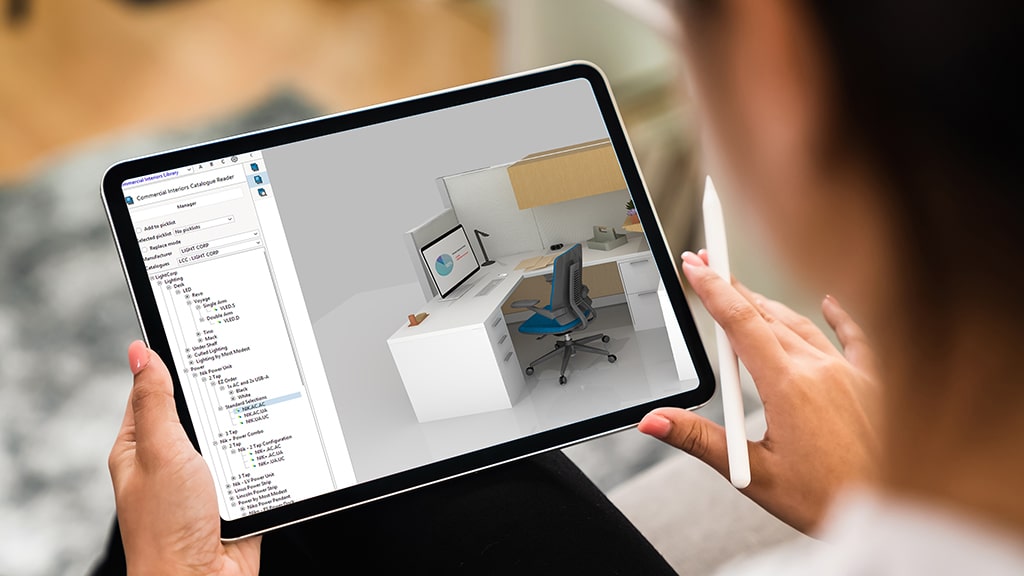
One of the biggest challenges space planners face when planning power for workspaces is selecting power solutions that look adequate in on-screen layouts, but fall short in reality. Most office power is planned for static use, even though today’s workplace is anything but. Since the pandemic, how workers now experience the office has changed dramatically.
Employees now move through a palette of locations beyond individual workstations throughout the day, including conference rooms, multi-functional, agile zones, social lounge areas, and cafeterias.
The number of devices we use per day is growing, too. While three devices per user is typical, hybrid workers, designers, and knowledge workers might use as many as four to five devices and mobile tools, all of which require access to power.
Since 2020, office real estate in the U.S. has declined an average of 6–10%. Many companies now plan space for hybrid use rather than full-time occupancy. As a result, offices today must be agile enough to reconfigure as needed, often creating a higher device density per square foot.
When space shrinks, every design decision has to work harder—especially power access.
What Happens When There Isn’t Enough Power in the Office
If power hasn’t been mindfully considered, it becomes apparent once the space is in use. One of the most visible signs is workers becoming tethered to wall outlets. Power access can begin to dictate where people work, often forcing them to work from non‑ergonomic locations for longer than they would like. In shared spaces, certain seats become more desirable simply because they are close to an outlet.
Another clue that power access was an afterthought in the space-planning process is an overreliance on power strips to supply power to workspaces. Besides disrupting the visual aesthetic, extension cords can snake through high‑traffic areas, creating visual clutter and potential safety concerns.
When power becomes a scarce commodity that users must hunt for or compete for, the impact extends beyond inconvenience and visual clutter.
Instead of focusing on their work, users spend time managing their setup and managing their anxiety and distraction. They may need to ration outlets, rotate chargers, or choose where to sit based on power access rather than the task at hand. Focus drops, productivity suffers, and it becomes harder to maintain momentum.
Limited access to power also restricts how people move and collaborate. It can quietly dictate how many people gather, where they gather, and how long they stay. When users hesitate to move between tasks or teams because they might lose access to power, flexibility starts to break down.
Designing Office Power Around How People Actually Work
Solving these challenges starts with a shift in perspective. Power should not be designed around static layouts— it should be designed around behavior. Put another way, power must follow the user.
That means understanding how people move throughout the day, how spaces are shared, and what kinds of connections and devices teams rely on most. (Hot tip: If you don’t know, ask! Involve the customer’s IT department before orders are placed to ensure the right kinds of power, such as AC, USB, etc., are considered) Individual desks, conference rooms, social zones, and agile team areas all require power access that supports change, not just initial placement.
As previously mentioned, today’s spaces need to do more and accommodate growth or reconfiguration. Spaces should be able to adapt quickly without forcing users to navigate through a mess of cords or work around fixed limitations, such as too few wall outlets.
What Effective Office Power Access Looks Like in Practice
When done right, power is available where work happens, without requiring users to search for it, work around it, or adjust their behavior to accommodate it.
- At workstations, that means desktop and table‑mounted solutions that keep access within reach and allow users to stay focused on their tasks.
- In meeting or conference spaces, it’s generous, well‑placed outlets that are evenly distributed, allowing seats to be chosen freely, not by proximity to an outlet.
- In common areas and social zones, it’s options integrated into soft furnishings, built into tables, or provided through nearby freestanding units, so these areas remain multi-functional throughout the day.
Above all, effective power planning supports inevitable change. It allows spaces to reconfigure easily as projects require or layouts shift. When users can ‘unplug and roll’ without untangling a web of cords, the space stays flexible and agile, supporting how today’s teams actually work.
How LightCorp Supports Better Office Power Planning
Need help planning power? Tap into our power expertise! Our products are made to order in Grand Haven, Michigan, in 10 days or less, with one of the best on-time delivery rates in the business. See what we have to offer at LightCorp.com.