
Workplace lighting shapes how a space functions far more than most design plans account for. Designers typically prioritize furniture, paint colors, and flooring, then add illumination afterward to complement those choices. However, that sequence undersells the extent to which lighting affects the workday, particularly at individual workstations.
A deliberate lighting plan considers both the overall environment and the light available where work actually happens. Ambient lighting establishes the general brightness of a room, while task lighting provides more focused illumination at desks and other work areas. Considering both early in the design process gives designers greater control over visual comfort, workstation functionality, and the overall experience of the space.
What Workplace Lighting Contributes to Office Design
Every workstation depends on light to function properly throughout the day. Overhead or ambient lighting can establish general visibility across the office, but it may not provide the focused illumination needed for detailed tasks at a desk. Task lighting fills that role by bringing light closer to the work surface.
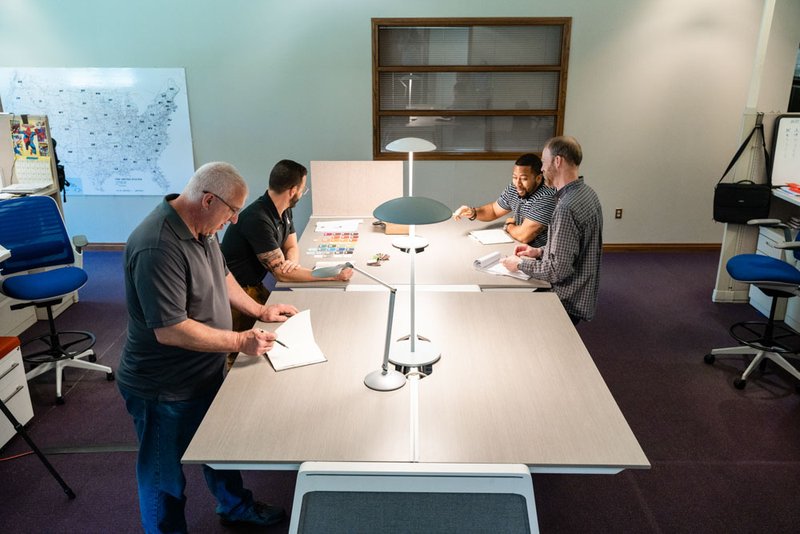
Workplace lighting shapes a workstation in a few distinct ways, such as:
- Overall Brightness. Ambient lighting sets the room's overall brightness, while task lighting provides focused illumination. Using both can meet the lighting needs of the entire space without relying on a single source for every purpose.
- Visual Comfort. Properly positioned task lighting can provide focused illumination while helping limit shadows and glare across the work surface. Even, well-placed lighting can also make it easier to maintain visual comfort throughout the workday. Cornell research found that workers in well-lit environments reported a 56% reduction in drowsiness and a 63% drop in headaches.
- Mood and Tone. Both ambient and task lighting can use warmer or cooler color temperatures depending on the needs of the space and its users. Warmer light can create a relaxed, informal feel at a workstation, while cooler temperatures tend to energize a space and sharpen focus.
- Foundation for Other Design Choices. Furniture and finishes get selected around workplace lighting rather than the reverse. Weak lighting undermines even well-chosen nearby furniture and materials.
Because workplace lighting affects every task performed at a desk, product choice matters fundamentally. Getting that foundation right remains central to designing for visual comfort across a workspace.
Why Workplace Lighting Belongs in the Early Design Phase
Workplace lighting decisions carry more influence when made before other elements are finalized. Many workstation choices depend on decisions that come earlier in a project, and lighting is one of the first in that sequence. Treating it as an afterthought disrupts that order and limits its overall impact.
Task lighting makes this planning especially important. A fixture mounted beneath a shelf, attached to a desk, or positioned elsewhere at the workstation needs to work with the surrounding furniture configuration.
Several practical realities explain why mapping out workplace lighting early pays off:
- Power Planning. Many task fixtures rely on outlets or in-desk power sources positioned near each workstation. Planning that placement early prevents costly rework once furniture and power lines are already installed.
- Furniture Alignment. Desks and seating get positioned in relation to where light falls, not independently of it. Committing to a lighting plan first keeps that alignment consistent across every workstation.
- Budget Predictability. Early specification gives designers a clearer picture of what fits within the project’s budget and timeline. Consequently, decisions made early leave more room to adjust other elements as a project progresses.
Sequence matters as much as the individual decisions made within a project. Workplace lighting, when addressed early, lays the foundation for the rest of office design to build on. That foundation is what separates a workstation that functions well from one that simply looks finished.
What to Look for When Specifying Workplace Lighting
Choosing a fixture is only one part of specifying workplace lighting for a commercial project. Designers are also choosing a manufacturer, a delivery timeline, and a level of support that extends well past installation. A single project might involve dozens of workstations, so a manufacturer's ability to deliver consistently across a large order becomes just as relevant as the quality of any single unit.

A few factors separate a dependable choice from one that creates problems later:
- Delivery Timeline. A firm placing an order for 40 workstations needs confirmation that all fixtures will arrive together, not in scattered batches. A dependable timeline keeps installation crews on schedule, preventing multiple site visits.
- Documentation Access. Electricians and installers need accurate specs before fixtures ever reach a site. Projects that rely on office lighting designed for comfort and productivity benefit from documentation that is available before final approvals, not after.
- Consistency Across Units. A workstation lit differently from the one beside it creates a visibly uneven space. Manufacturers capable of producing consistent task lighting across large orders help maintain a uniform experience across the project.
- Cost Relative to Lifespan. A lower price loses its advantage quickly if fixtures fail within a year or two. Total cost includes replacement, labor, and the disruption caused by pulling a workstation out of use.
Specification is where early planning either pays off or falls apart. A strong lighting plan only holds up when the partner delivering it can meet the project's functional, aesthetic, and scheduling requirements.
Find the Right Lighting Solutions at LightCorp
Good workplace lighting takes real planning, not an afterthought squeezed in once everything else is decided. When it gets the attention it deserves early on, the rest of a workstation tends to fall into place more smoothly.
At LightCorp, we design and manufacture task lighting built for fast-moving commercial projects, with a standard ten-day lead time and specs ready when designers need them. Reach out to our team to find the right lighting solution for the next project.