
Modern office designs increasingly prioritize both daily utility and employees' overall well-being. Because of this trend, commercial interior designers must create layouts that promote high productivity while keeping occupants safe from eye strain and fatigue. Achieving this ideal result depends heavily on the thoughtful application of modern office lighting.
This article outlines the typical mistakes that designers make when choosing fixtures for workspaces. It also explores practical strategies to maintain excellent visibility while protecting long-term visual comfort.
Common Problems with Modern Office Lighting
Balancing the lighting needs of a workspace can be challenging when a single floor plan must accommodate quiet focus zones and open collaborative benches simultaneously. Because these dynamic environments require different visual conditions, relying solely on uniform ceiling troffers or non-dimmable linear pendants can quickly ruin the functionality of a beautiful layout.
The following list highlights common design oversights when planning modern office lighting for complex layouts.
- The Brightness Misconception. A common workspace lighting myth is that brighter offices make for better work environments. In reality, maximizing brightness without adding localized control causes immediate visual fatigue. Moreover, it unnecessarily increases corporate energy costs and washes out the architectural contrast of the interior design
- The Interrogation Room Effect. Installing too many high-output overhead fixtures across an open-plan layout creates intense, high-contrast glare on computer screens. This excessive exposure to direct light sources can quickly lead to severe eye strain and tension headaches for daily users.
- The Cave Effect. Dimmer illumination is typically associated with a cozy, comfortable vibe. However, this choice often leaves individual desks dark and impractical for everyday work. This can make end users struggle to read printed text or review contracts comfortably without a secondary light source, especially for older workers.
- The Fixed-Grid Trap. Positioning fixtures in a rigid, uniform ceiling pattern fails to account for where desk groupings and collaborative benches may actually sit, both after installation and in the future as office layouts may change down the road. This placement often casts deep shadows directly over workstations, severely reducing visibility.
- The Natural Light Overlook. Failing to plan for changing daylight levels near large exterior windows leaves perimeter desks exposed to blinding natural glare during peak afternoon hours. Without adjustable indoor options, the contrast between the shifting outdoor sun and fixed interior modern office lighting makes screen work incredibly uncomfortable.
The Balancing Act: Ways to Ensure Comfort While Maintaining Visibility
Striking a balance between comfort and visibility in office spaces requires treating modern office lighting as a multi-layered system rather than a uniform light source. Taking this approach allows designers to easily build out workspaces that protect long-term optical health while keeping focused task areas highly functional.
In the following section, we’ll provide a practical roadmap for implementing office lighting that supports both baseline comfort and localized performance.
Consider Ambient Lighting as a Soft Foundation
Creating layers with light usually begins by establishing a low-contrast baseline level of illumination throughout the entire workspace. This approach ensures that the lighting foundation provides sufficient visibility for safe navigation while remaining comfortable for the eyes during long working hours.
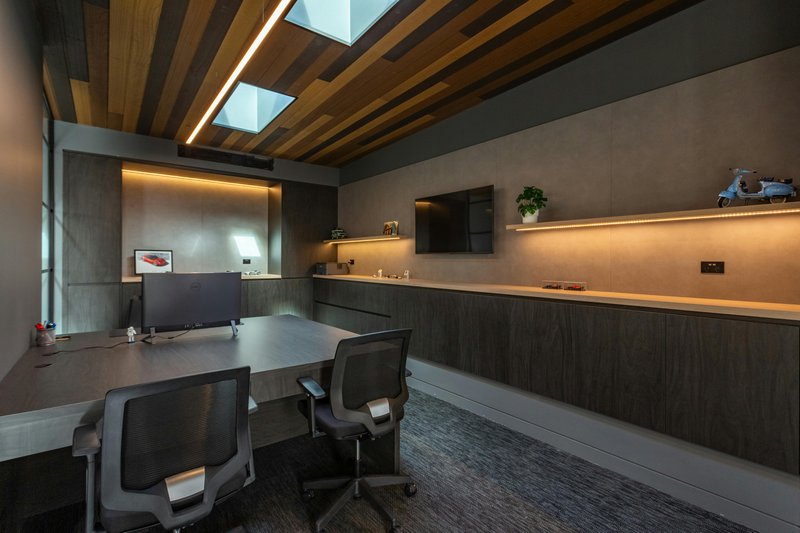
Designers can successfully execute this by implementing a few targeted layout tactics.
- Use indirect architectural fixtures. Instead of high-output ceiling fixtures, opt for indirect pendants that bounce light off the ceiling. This will scatter the light more evenly and eliminate harsh screen reflections.
- Integrate under-the-shelf lighting. Installing slim, low-profile linear fixtures underneath overhead storage compartments or floating shelves provides a soft wash of light across the desk surface, filling in localized dark spots without adding unnecessary overhead brightness.
- Position low-output ambient table lamps. Placing soft, diffused table lamps in casual lounge areas or corner touch-down stations adds warm layers of baseline light that make the overall environment feel inviting and comfortable.
Incorporate Task Lighting for Localized Precision
Once the ambient layer is set, directional fixtures provide the necessary illumination for focused work. Integrating personal task lighting allows designers to keep ceiling brightness comfortably low while giving individuals total control over their immediate environment.
Designers can incorporate these localized solutions by choosing targeted product styles for different workstations:
- Implement a dual-source offset strategy. Instead of centering a task light directly in front of a monitor, position an adjustable desk lamp or table lamp off to the side. This placement casts a crisp field of light across physical documents while preventing hot-spot reflections from bouncing off screens.
- Create functional focus micro-zones. Position specialized floor-mounted reading lights adjacent to lounge seating and collaborative booths. This transforms casual, low-light breakout areas into high-visibility modern office lighting workspaces without altering surrounding levels.
Integrate Layered Controls and Dimming Zones
A visually balanced work environment requires a system that adapts as spatial needs shift throughout the workday. Implementing a network of separate dimming zones ensures that the overall office lighting plan remains responsive to changing natural conditions and diverse user tasks.
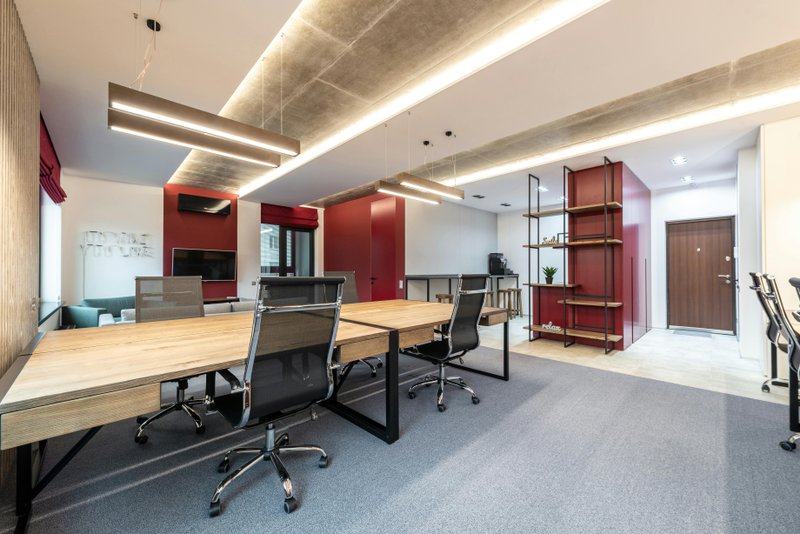
Designers can establish this crucial flexibility by applying targeted architectural control strategies.
- Separate window-side lighting circuits. Wire the fixtures closest to large windows on their own independent switch. This lets users easily dim the lights nearest the glass during bright afternoons, preventing blinding screen glare.
- Create localized dimming zones. Adaptable lighting configurations are a must for agile workspaces. Consider grouping manual dimmers by specific team areas or structural bays rather than controlling the entire floor with a single switch. This approach to lighting will help end users maintain brightness levels, however they see fit.
Choose Materials and Finishes Carefully to Manage Reflections
Fixtures are not the only thing to consider when it comes to office lighting; the surfaces they illuminate play an equally critical role in visual comfort. Choosing non-reflective materials prevents harsh light from creating glare that strains the user’s vision.
Designers can manage these surface reflections effectively by matching architectural textures with targeted hardware solutions:
- Opt for low-sheen matte laminates. Opt for work surfaces with a non-reflective matte finish to diffuse downward light. Pairing these surfaces with an adjustable desk lamp creates a soft, flattering, glare-free wash of light across physical documents.
- Install fabric wall panels. Mount textured textile panels or matte backsplashes along vertical workstations. This treatment absorbs stray rays from under-the-shelf lighting, ensuring smooth, comfortable diffusion without harsh hotspots.
Find Modern Office Lighting Solutions
Configuring lighting for modern office designs requires high-performance fixtures built for evolving workspaces. Lightcorp delivers this versatility through a premium portfolio of adjustable desk lamps, low-profile table lamps, and streamlined under-the-shelf lighting designed to eliminate glare and maximize user comfort. These adaptable architectural tools give designers precise control over both ambient baselines and focused task zones.
Get in touch with us today for more information about our lighting solutions.