
A well-lit room doesn’t automatically make for a well-lit workspace. Standard overhead fixtures spread ambient light across an entire room, often leaving individual desks dim and under-illuminated. Under-shelf lighting can correct this mismatch by placing focused light right where close work happens.
Workstations without dedicated lighting quickly create everyday friction: harsh screen glare, shadowed documents, and a single brightness level that rarely satisfies everyone. By delivering direct, adjustable illumination straight to the work surface, under-shelf lighting eliminates these roadblocks. Here is how those advantages play out across compact and shared environments.
Accurate Lighting Even as the Workstation Changes
Overhead lighting plans capture a single moment in time. As tenants shift, partitions move, and wall-mounted storage is added, those original layouts quickly fall out of sync. For example, a new overhead bin may block light from reaching the desk, while high partitions cast shadows on the ambient light designed to fill those gaps.
Mounting light directly to the furniture breaks this cycle. When lighting is integrated at the desk level, you gain critical operational advantages:
- Eliminates the need for a redesign after a reconfiguration. Storage can shift or expand without leaving the desk underlit again.
- Reduced dependency on the original lighting plan. A desk stays lit correctly even where the ceiling plan never accounted for its current storage.
- No disruption during tenant turnover. Light output holds steady through renovations, without waiting on an updated overhead plan.
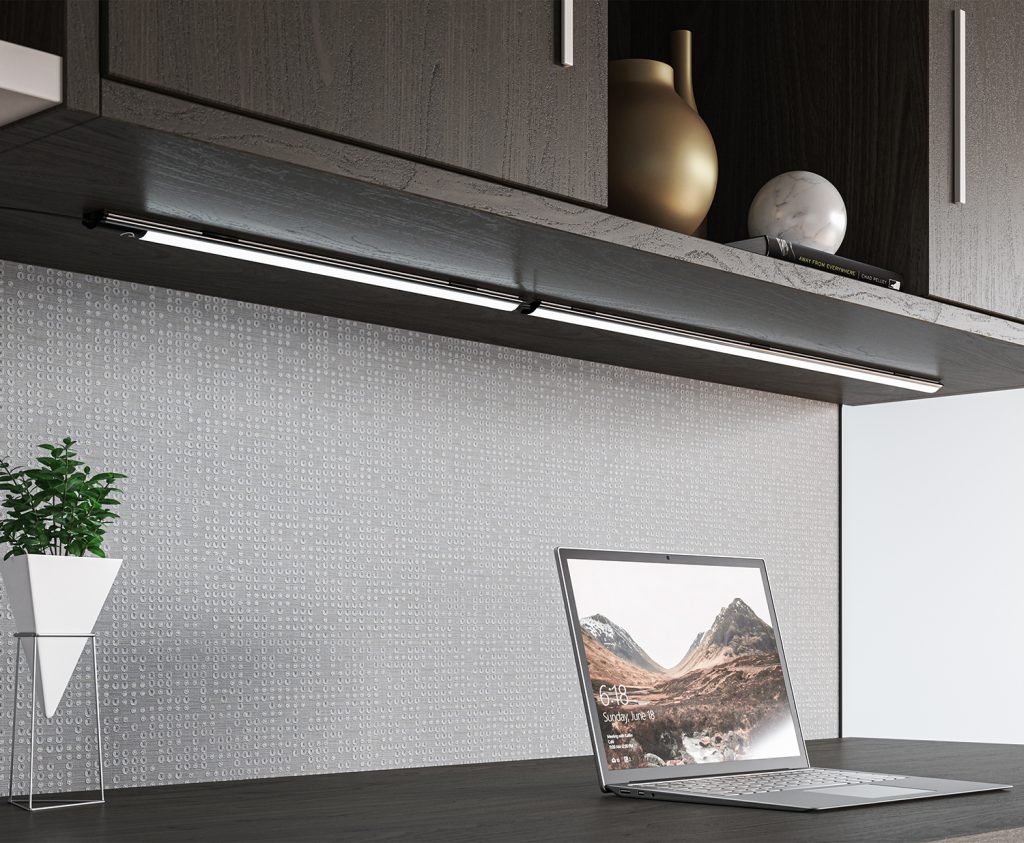
Furniture changes happen more often as offices adopt desk sharing, with 60% of U.S. and Canadian employers now using this model. Each new arrangement can leave a gap between the original lighting plan and what a workstation actually needs. A desk lit this way keeps performing through changes like these.
Closing the Gap Between Functionality and Comfort
A workstation can pass general lighting standards on paper and still feel terrible to work at. Meeting baseline code requirements says nothing about how a specific desk functions once an employee sits down. Under-shelf lighting solves this disconnect by solving for the individual user rather than the overall floor plan.
Bridging that gap directly improves the daily work experience:
- Reduced Screen Reflections: Displays remain clear and legible without harsh overhead glare competing for visual focus.
- Shadow-Free Documentation: Papers and reference materials remain fully visible without requiring users to shift around to find the light.
- Lower Visual Strain: Sustained focus feels less exhausting when surface brightness remains steady and balanced throughout the day.
Comfort at the desk directly affects how long someone can focus without fatigue. Consistent, well-placed light plays into how offices balance comfort and productivity at a larger scale. The same principle holds true at the individual desk, where comfort shapes daily satisfaction.
Puts Control Where a Fixed Light Setting Falls Short
A single overhead setting is built around one assumed user, even though no workstation is ever used by just one type of person. Age, task, and individual sensitivity all affect how much light someone actually needs, and a fixed level can't adjust for any of them. Under-shelf lighting solves this by moving control to the desk itself.
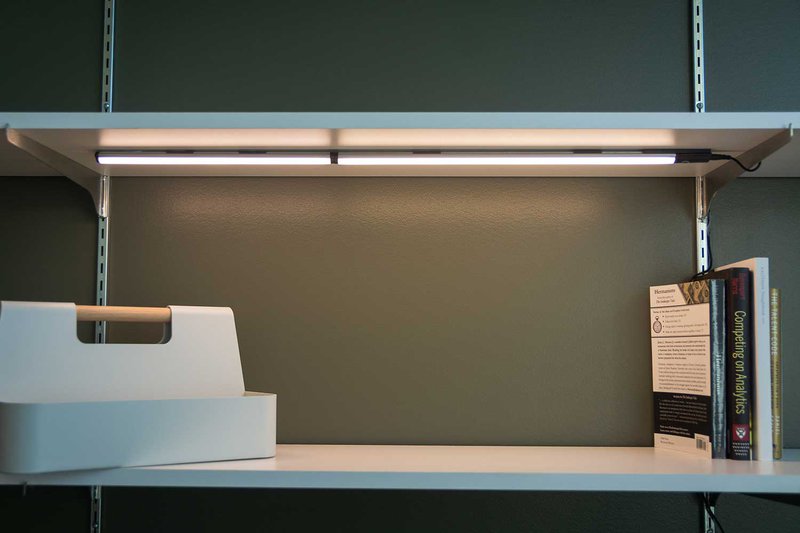
Under-shelf lighting removes that compromise by letting brightness adjust at the individual desk:
- Age-related differences in visual need. A worker in their fifties may need roughly twice as much light as a worker in their twenties to read the same text clearly, and individual control lets each person set their own level.
- Task-specific brightness preferences. Detailed work like proofing or drafting calls for more light than general computer use, and individual control lets someone dial that up only when the task demands it.
- Fewer complaints routed back to facilities. When people can adjust their own lighting, requests for a brighter or dimmer overhead setting no longer land on a facilities team that can't satisfy everyone at once.
Control as this fits into broader workspace lighting strategies for agile offices, where the same station often serves different people throughout the week. Individual comfort becomes part of the design itself, not an afterthought. Satisfaction improves when people adjust their own light instead of accepting a single fixed setting.
Installs Without Disrupting Work
Retrofitting overhead lighting usually means new wiring, an electrician, and a desk that sits unusable for the length of the job. Facilities teams rarely have that kind of downtime to spare, especially in a building that's already occupied. Under-shelf lighting operates on the existing power at the desk, avoiding that disruption entirely.
That difference changes what a project actually requires to complete:
- No new electrical work. Fixtures connect directly to the existing power, including commercial power solutions at the station, so no electrician needs to open a wall.
- Fewer separate power connections across a row. Linked fixtures share a single connection point instead of requiring one per desk, cutting down the wiring a project actually needs.
- No scheduled downtime for the desk. Quick-attach mounting installs a fixture in minutes, so the workstation stays usable throughout the process.
Facilities teams can complete installation of under-shelf lighting for an entire row of desks in a single visit. This makes the fixture a natural fit for phased upgrades. Dealers gain a solution that fits an existing budget and timeline, not one that expands it.
Under-Shelf Lighting Solutions You Can Trust
All of these issues trace back to one basic conflict: static lighting in a dynamic space. Overhead plans become obsolete as soon as furniture moves or daily tasks shift, whereas lighting mounted directly at the desk moves and adapts with the environment. Choosing to design for ongoing flexibility rather than a fixed layout helps keep a workspace comfortable over time.
At LightCorp, we design under-shelf lighting for exactly that kind of change, backed by a standard 10-day lead time and support for planning daisy-chained runs across a row. Every project brings different demands, and we match the right fixture to each one. Reach out to our team to start the next project.